
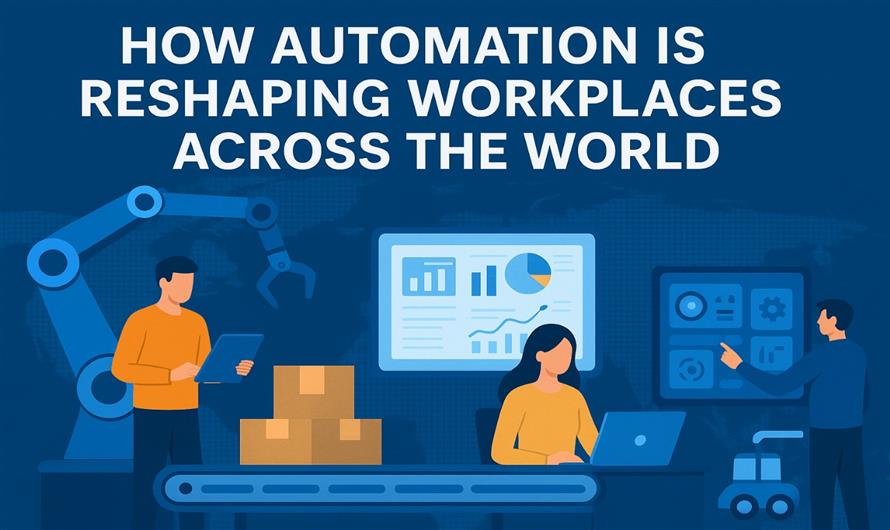
How Automation Is Reshaping Workplaces Across the World
Our technological and interconnected world has made the word "automation" a source of hope and fear. In factories and in offices, machines and computers are redefining work for humans. Automation is less a story about machines and more a people's story of adaptation, learning, and learning to stay in place in an ever-changing environment.
The Start of Automation
Automation began centuries ago. It began during the Industrial Revolution, when machines had already begun replacing human workers in factories. Today, though, is light years beyond that. Automation today is powered by analytics, artificial intelligence, and robotics. Today, machines are capable of performing tasks that once needed human judgment—such as information processing, logistics management, or even reports writing.
All sectors, big or small, have seen this change. Banks employ chatbots to assist customers 24/7. Factories employ robot arms for delicate tasks. Retail stores automate stock management. Even farming has drones and smart sensors to check crop level. Something that was once referred to as futuristic is now a part of our regular work life.
Benefits of Automation in the Workplace
The most apparent and initial benefit of automation is efficiency. Machines never tire, lose concentration, or fall ill. They can execute repetitive tasks faster and more efficiently than humans. This leads to lower bills, faster manufacturing, and less error for business entities. For example, in automobile plants, robots can install parts with precision to a millimeter that will take humans longer to achieve.
Automation also guarantees security. In operations such as mining, building, or manufacturing chemicals, the robots perform dangerous tasks, and the rate of accidents and death is minimized. Similarly in hospitals, automated processes guarantee they adhere to patient histories, administer medication accurately, and even assist in surgical procedures, allowing physicians to cure patients instead of filling out paperwork.
Another major advantage is processing data. Computer applications can process huge amounts of data which would take human agents centuries to do in terms of time. Businesses are able to study customer patterns, predict trends in the market, and make decisions based on data all because of computer operations working in the background.
Challenges and Concerns
Even as the benefits are staring one in the face, automation also came with very harsh problems with work in the future. Job loss is one of these harsh problems. As machines and computer programs become more capable of handling day jobs, various workers are made to feel threatened by their employment. For example, self-checkout lanes at supermarkets reduce the need for cashiers, and drone delivery might displace drivers in the future.
But experience bears out the fact that every technological revolution draws new windows of opportunity and shuts some of the older ones. Adaptation is the key word. Employees upgrading their competence to be compatible with new technology have a decent chance of survival. Instead of performing mechanical repetitive tasks, they can shift to jobs involving creativity, decision-making, and problem-solving skills which are yet to be discovered by machines.
Digital divide is a problem too. Not all employees working or working for a business are properly equipped with automated tools. Small enterprises lack the capability to invest in high-tech systems, and workers in developing countries may not receive training. This may generate economic inequalities unless addressed with the proper education and government assistance.
Changing Skills and New Opportunities
Automation not just takes away employment but also the kind of skill set required. Repetitive data entry or assembly jobs are being substituted with human-decision-making jobs. Repairing robotics, coding, data analysis, and digital marketing careers are growing at an exponential level.
Less hard skills such as imagination, empathy, communications, and critical thinking become no less critical than technical skills. The computers will do the math, but can't relate on an emotional basis or think ethically. That gives a unique advantage to humans. The future workplace will more than likely merge the accuracy of the computers with human imagination.
Education systems are being redesigned to cater to this requirement. International schools and colleges are including subjects in coding, automation engineering, and AI in their curriculum. Lifelong learning is no longer a choice. Professionals today take online tutorials or workshops to stay updated with their working field.
The Human Side of Automation
In all the hype about technology, one can lose sight of the fact that automation is actually meant to assist and not replace people. The goal is not to remove work from people but to remove the drudgery and the mundane work so human beings can spend time on other activities.
In the workplace, personal electronic aides and scheduling software free workers from clerical work. In hospitals, machines may be programmed to monitor patients for the nurses. In writing and design, writing and design software help writers and designers perform their tasks properly and yet creatively. Automation, when well done, might make work more challenging and fulfilling.
The Road Ahead
The future of automation depends on what society desires to balance technology and human beings. Governments and institutions have to develop policies that serve the masses of people working in transition via retraining schemes, fair compensation and exposure to technology. Enterprises should utilize automation in ways that productivity benefits accrue to everyone, and not a selected few.
To humanity, the best plan is to remain curious and flexible. The future career is maybe not yet discussed today, but whoever keeps learning will never run out of room. Automation is not the end of human labor but the beginning of new coexistence between human beings and machines.
Conclusion
Automation is reshaping and shaking up workplaces around the world. It's making businesses smarter, safer and more agile and also challenging us to redefine the future of work. Instead of resisting change, we must welcome it with vision and imagination. The future will belong to those who will use technology to enhance, not replace, the human touch.


Leave Comment